
Explore today: Your future, our programs
Courses
Semester I - year 1 (foundation year)
| Course Code | Course Title | Credit hrs |
|---|---|---|
|
FDY-101 |
2 Dimensionality: Drawing & Surface Tensions |
3 |
|
FDY-102 |
3 Dimensionality: Space & Form |
3 |
|
FDY-103 |
4 Dimensionality: Time, Virtuality & AI |
3 |
|
FDY-104 |
Contextuality: Art, Society & Civics |
3 |
|
FDY-105 |
Visuality: Form and Content |
3 |
|
FDY-106 |
Memory: Visual Culture Through Time |
3 |
|
GEN-104 |
Functional English (1up) |
3 |
| Total | 21 |
Semester II - year 1 (foundation year)
| Course Code | Course Title | Credit hrs |
|---|---|---|
|
- |
Foundational Studio Elective (module based) |
3 |
|
- |
Foundational Studio Elective (module based) |
3 |
|
- |
Foundational Studio Elective (module based) |
3 |
|
- |
Foundational Studio Elective (module based) |
3 |
|
FDY-115 / FDY-116 / FDY-129 |
Foundational Theory Elective |
3 |
|
FDY-117 / FDY-118 / FDY-137 / FDY-130 |
Foundational Theory Elective |
3 |
|
GEN-120 |
Introduction to Liberal Arts |
3 |
| Total | 21 |
Foundational Mandatory Courses
Visuality: Form and Content | Semester 1
Course Code: FDY-105 | Contact Time: 3 Hours Per Week | Credits: 3 | Theory
This course concentrates on the basics of visual language, beginning with the elements and principles common to all fields of art and design. After learning to interpret inherent meaning in form through seemingly universal symbols like shapes, colors, and others, the course moves on to explore “reading images” as narratives in relevance to history, society and popular culture. Students will learn to decipher the constructed stereotypes of power, race, gender and class through exposure to a wide range of visual communication forms like advertisement, film, architecture, textile, and others.
Memory: Visual Culture Through Time | Semester 1
Course Code: FDY-106 | Contact Time: 3 Hours per week | Credits: 3 | Theory
The course offers an introduction to the different ideas that have underpinned visual culture and vocabularies through history. It employs a thematic interdisciplinary lens that encompasses artistic expression, design, popular culture, news, science, optic technologies and other visual manifestation of human modes of living. The course aims to foster the relevancy of human creativity beyond the typical classification of time and region. Instead, students are expected to use conceptual lenses to analyse comparative ideas, thus connecting the past to the present and the future.
Contextuality: Theory and Practice | Semester 1
Course Code: FDY-104 | Contact Time: 6 Hours per week | Credits: 3 | Theory/Studio
Creating thought and research are simultaneous and interconnected processes. This course is premised on these relationships. It is structured as a hybrid with both studio and theory components organised around different thematic lenses. The course aims to introduce students to the complex history of creative inquiry and its shifting currency. Students are expected to be self-reflective within the production of their work, as well as when considering varying understandings of it across different social, artistic and intellectual contexts.
4-Dimensionality: Time and Virtuality | Semester 1
Course Code: FDY-103 | Contact Time: 6 Hours per week | Credits: 3 | Studio
Our lives today are divided in two: the real and the simulated. This course considers how to artistically tackle this gap between the physical and the virtual: space and time. It offers an in-depth look at the virtual realm, including the internet, forms of digital image-making and time-based mediums. Simultaneously, students are introduced to conceptual themes relevant to new media today. They also explore sound, video production, and creative coding as an approach to storytelling and self-expression, cementing the link between the physical and digital world.
3-Dimensionality: Space and Form | Semester 1
Course Code: FDY-102 | Contact Time: 6 Hours per week | Credits: 3 | Studio
This introductory course explores broad themes within three-dimensionality through a diverse range of materials, tools, and methods while simultaneously focusing on individual conceptual and stylistics concerns. Students will cover basic sculptural techniques like moulding/casting, additive and subtractive methods like carving, welding, and others. While teaching students the fundamentals of scale, texture, weight and movement through developing a vocabulary of fabrication solutions in the studio, this course also aims to help them contextualise their practice within a historical and contemporary discourse of three-dimensionality.
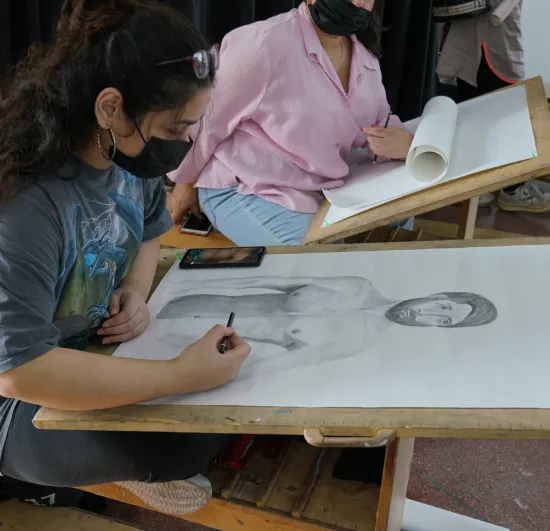
2-Dimensionality: Drawing and Surface Tensions | Semester 1
Course Code: FDY-101 | Contact Time: 6 Hours per week | Credits: 3 | Studio
The condition of flatness is explored both conceptually and formally in this course. It examines various issues in 2-dimensional discourse such as the limits of framing; shifts and illusions of depth; perspective as it shapes our view of reality; the relationship of a viewer with a 2-dimensional surface and the ways in which such work may be shared. Students are expected to work with a variety of mediums and methods of mark making through which they understand drawing and other two-dimensional media as languages in their own right.
Foundational Studio Electives
Typography and Layout | Semester 2
Course Code: FDY-108 | Contact Time: 6 Hours per week | Credits: 3 | Studio
This course will address type, typesetting, and layouts for various integrated formats. Today the role of type is larger than just print media. This course will introduce the basics of typography and its implementation in various formats. Students are familiarized with specific terminology regarding font classification, measurement, placement and page arrangement. Further emphasis is placed on understanding the semiotic value of typefaces and the importance of applying them appropriately to the message.
Animation and Interactive Arts | Semester 2
Course Code: FDY-109 | Contact Time: 6 Hours per week | Credits: 3 | Studio
This course for foundation year students will allow them to understand the basics of interaction and animation. Students will study traditional techniques and develop a more concise observation in both disciplines. The core focus of this course is to explore and teach the fundamental skills and principles of traditional and basic digital animation along with its implementation in the interactive arts. Students are assessed on their synthesis of this learning from the perspective of skills in way that develops and enhances communication.
Introduction to Painting | Semester 2
Course Code: FDY-110 | Contact Time: 6 Hours per week | Credits: 3 | Studio
This course is an introduction to the elementary concepts and techniques of painting. These include color theory, pictorial plane, surface and imagery inter-relationships, surface preparation, palette works and others. It will focus on three primary areas: material applied, techniques of application and variety of surfaces. The course projects enhance observation skills and provide an opportunity to acquire confidence in the medium through freedom of experimentation with diverse media. Students are expected to gain a basic understanding of formal pictorial elements as well as conceptual aspects of painting.
Lens Based Media: Video & Photography for Beginners | Semester 2
Course Code: FDY-111 | Contact Time: 6 Hours per week | Credits: 3 | Studio
Through an introduction to the elements of digital media, students are grounded in the basic functions of photographic equipment and the principles of recording light. They are given a broad interdisciplinary understanding of concepts related to imaging, sound, video and interactivity. Lectures and discussions survey the history of artists using digital media. At the end of the course the students are expected to have confidence in handling a photographic shoot and creating videos with the simultaneous and complex goals of creative freedom and technical expertise.
Fibre, Weave and Surface Studies | Semester 2
Course Code: FDY-113 | Contact Time: 6 hours per week | Credits: 3 | Studio
This is a thematically driven course designed to reconfigure and build upon knowledge of two-dimensional surfaces from within the sensibility of fibre and the broad notion of textiles. This approach is expected to push boundaries and is primarily concerned with the application of two-dimensional elements for gaining creative and visual starting points. The course builds the students’ foundation of working on the table-loom developing textures and surfaces using a variety of materials like paper, textile, fibre and found material, as well as incorporating a detailed study of colour systems to create surfaces.
3D Construction: Through Draping and Pattern | Semester 2
Course Code: FDY-112 | Contact Time: 6 Hours per week | Credits: 3 | Studio
This course develops students’ prior knowledge of three-dimensional designs by focusing on techniques and processes of construction used in fashion, accessory design and other sculptural fields. Students learn how to convert 2D materials into 3D forms through an introduction to fundamental garment manufacture and production. Pattern-making and draping techniques are covered with a focus on the structure, forms and contours of the body as well as other objects in three-dimension. This fusion enables students to develop a thorough understanding of material behavior and construction.
Prototyping: Concept to Form
Course Code: FDY-120 | Contact Time: 6 Hours per week | Credits: 3 | Studio
This course focuses on developing students’ abilities to take a thought from being just an intangible idea all the way to a tangible physicality. Through working with ideation exercises as well as material processes, this course gives students a broad-based understanding of form by experimenting with a wide variety of techniques, creating an intersection between the fine arts, jewellery and other design-centric fields. The emphasis is on the process of conceptualization and then bringing the planned form to fruition using relevant material processes.
Drawing Production | Semester 2
Course Code: FDY-114 | Contact Time: 6 Hours per week | Credits: 3 | Studio
This course seeks to encourage students to be more experimental at exploring diverse possibilities and media to produce drawings. Drawing is not seen in the conventional sense as preparatory study for later work. Rather, it is considered as an effective mode of visual expression where every drawing is a carefully constructed work responding to some critical inquiry. Projects involve working with text, found images, exploring and examining contemporary visual culture and its impact on our society.
Introduction to Illustration | Semester 2
Course Code: FDY-114 | Contact Time: 6 Hours Per Week | Credits: 3 | Studio
In this drawing intensive course, students will explore various illustration techniques. From traditional medium to digital medium and everything in between this course will help students develop their own style. The course also aims at familiarizing students on how to generate new ideas, create visual narratives, undertake visual research and develop fluency in illustrative context. Thus, an equal emphasis relies on reading as well as drawing throughout the course.
Foundational Theory Electives
History of Visual Arts | Semester 2
Course Code: FDY-117 | Contact Time: 3 Hours per week | Credits: 3 | Theory
Objects and practices that we identify as art today arise from their specific historical, political and cultural conditions. This course attempts to unpack this context in terms of meaning and purpose of artistic practices, both intended at the time and subsequently established. While the chronological skeleton of the course ranges from the Enlightenment to the Contemporary, the structure lends itself to overlaps and connections beyond this framing. Students are expected to cultivate and apply visual literacy and critical analysis to the considered contexts, thus establishing a conversation with multiple pasts.
History of Communication Design | Semester 2
Course Code: FDY-118 | Contact Time: 3 Hours per week | Credits: 3 | Theory
What is Visual Communication Design? How did it arrive to be in its present state? How does it influence us and how do we influence it in return? This course will address these questions while observing the development of visual communication. It will touch upon key design movements in the industrial age that helped shape the world. However, while the discipline is presumed to be post-industrial, the course will also consider ancient history where the roots of the discipline were laid such as the development and evolution of the Roman alphabet.
History of Textile, Fashion and Accessory Design | Semester 2
Course Code: FDY-119 | Contact Time: 3 Hours per week | Credits: 3 | Theory
This course surveys the key historical design developments in textile, fashion and accessory from the Industrial Revolution to present times. The course explores core ideas, key designers and the everyday designed objects that form a part of our material culture. It aims to create both a conceptual and visual understanding of the diverse design aesthetic from the 19th to the 20th century by rooting it in its sociocultural, political, economic, and technological contexts. Ideological themes are explored ranging from the handcrafted aesthetic to industrial modernism and ultimately delving into ideas of Post Modernism and the Information age.
Research Methods in Art and Design
Course Code: FDY-115 | Contact Time: 3 Hours per week | Credits: 3 | Theory
How is it that we know things with certainty? What are some of the ways in which we can extend our present understanding of the world? This course offers initial answers to these questions by introducing students to a selection of research methodology in the arts. It considers the systematic accumulation and creation of knowledge from an interdisciplinary and practice-based perspective. Students are expected to apply this understanding to investigations that further their other practices and which may gain relevance even beyond the arts.
Academic Writing and Critical Reading
Course Code: FDY-116 | Contact Time: 3 Hours per week | Credits: 3 | Theory
Do U UndeRstaNd DiS? Chances are, your instructors do not. This course introduces students to conventions and techniques of writing in academic contexts. It covers logical argumentation; thesis claims and evidence; sourcing and citations; ethics and academic integrity; academic language and vocabulary; and standard writing formats. Students will also learn strategies of sustained reading practices and comprehension of complex texts. By the end of the course, students are expected to read confidently and write persuasively, skills that will remain useful for the rest of their academic and professional careers.