May, 08 2026
Pakistan’s Mediation as a Historical Trend
By Azra Emilia Ali
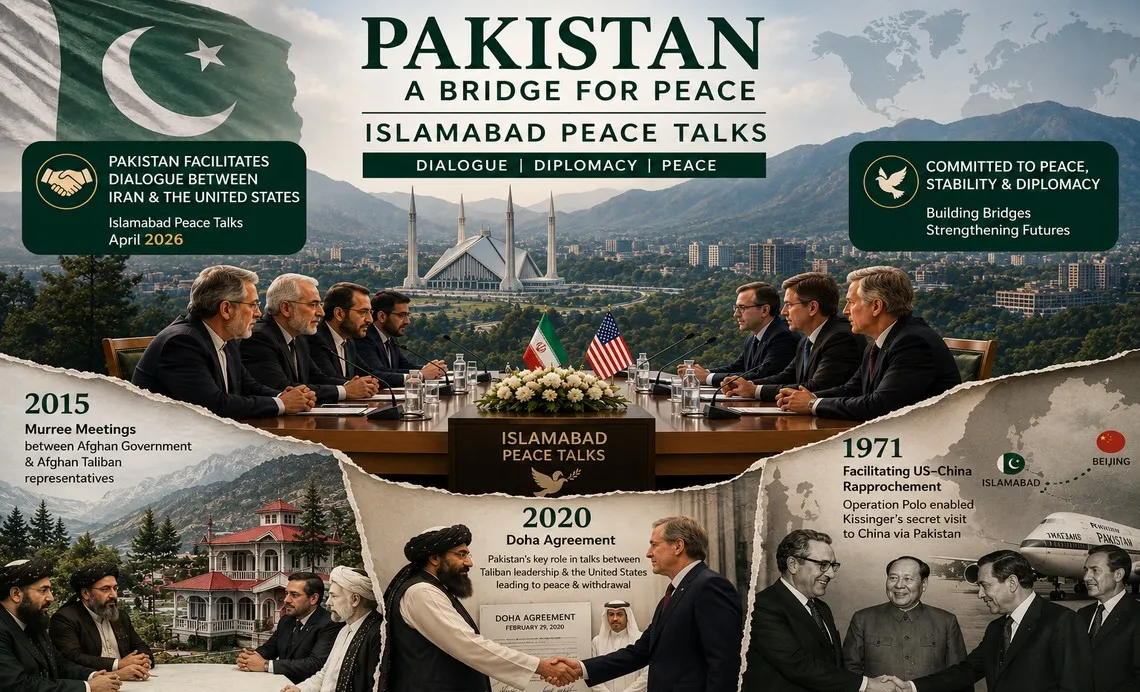
Pakistan stepped into the limelight recently with how it looked to play the role of mediator between Iran and the United States. While the Islamabad Peace Talks conducted in early April of this year did not end in a proper agreement between the involved parties or a signed memorandum of understanding, the situation did result in a tenuous ceasefire between Iran and the US, and helped create diplomatic credibility for Pakistan as a party interested in peace.
This is not the only time Pakistan has attempted to mediate relations between its neighbouring countries and the US. Pakistan can be observed as assuming that role multiple times in the history of the nation’s foreign ties, exhibited in Pakistan’s involvement in cases such as the 2020 Doha Agreement, and in the attempts at rapprochement between China and USA in the early 1970s.
Pakistan held meetings in Murree between the Afghan Government and Afghan Taliban representatives in 2015. And later in 2020 — with a more substantial outcome — was involved in talks between Taliban leadership and the United States, which resulted in the signing of the Doha Agreement and the withdrawal of American forces from Afghanistan.
Dr. Moeed Yusuf, currently Vice Chancellor of Beaconhouse National University and formerly Pakistan’s National Security Adviser and Special Assistant to the Prime Minister on National Security, was actively involved in Pakistan’s diplomatic engagement surrounding the Afghan peace process. He participated in high-level discussions with US officials and regional stakeholders, consistently advocating for a negotiated political settlement and intra-Afghan dialogue rather than a military solution.
Dr. Yusuf also represented Pakistan in strategic engagements concerning the Afghan reconciliation process and played an important role in shaping Pakistan’s policy approach during the negotiations that led to the Doha framework.
This tendency for mediation can be observed even earlier in the diplomatic timeline as well: in Pakistan’s facilitation of the US and China’s rapprochement.
Operation Polo, which entailed Henry Kissinger’s secret visit to Beijing in July of 1971, was made possible by President Yahya Khan and Pakistani diplomats’ connections to China. Kissinger’s talks with Chinese foreign minister Zhou Enlai opened the door for further diplomatic dialogue between both nations.
Without the covert flight the US National Security Advisor took from Islamabad to Beijing, US President Nixon’s subsequent visit to China and the chance to establish relatively more cordial relations between both countries would not have been possible.
In both these cases, Pakistan had become a mediator out of more than a sheer sense of altruism. Facilitating these dialogues offered the nation direct benefits, which ranged from stabilizing future relations with neighbours whose volatile political circumstances may otherwise come to affect Pakistan, securing consistent allyship with China, and subtly prioritizing its own national security.
In addition, Pakistan has used these situations as opportunities to construct a positive international image for itself as an agent for peace.
That motivation to secure a more stable position for Pakistan in its alliances and national security is mirrored in the present, as well. In possibly strengthening its relations with both the United States and Iran, and maintaining a reputation as a regional stabilizer, Pakistan stands to gain similar benefits by mediating here as it has in those aforementioned cases — even more so had the Islamabad Peace Talks resulted in success.
In conclusion, a trend can be outlined in Pakistan’s diplomatic history of acting as a mediator in global affairs, as evidenced at multiple points in the past. The efficacy of those efforts at mediation is another matter, however.
Pakistan has tried to incorporate this role into the image it presents to the international stage, but whether that image of the nation becomes a dominant one depends on if the peace it brokers can withstand the test of time.

Apply for Master of Art Education at BNU Lahore for Summer 2026. Check eligibility, scholarships, hostel, and admission process.

Explore BNU Lahore undergraduate programs for Fall Admissions 2026. Compare degrees, scholarships, hostel, and apply online.

Apply for MS Computer Science at BNU Lahore. Check eligibility, subjects, career scope, scholarships, and hostel details.

BNU's BS Hospitality Management prepares you for a global career in the service industry. CTH UK certified with merit scholarships up to 100%. Fall 2026 admissions are open.

Explore BNU's B.Ed program at the School of Education. Learn about admissions, curriculum, scholarships & careers. Fall 2026 admissions are open now.

Apply for BBA (Hons.) at BNU's School of Management Sciences. Early admissions open April 1, 2026. Explore scholarships, curriculum, campus facilities, and career opportunities.

Explore BNU scholarships. We offer fully funded scholarships for Pakistani students and need based scholarships to ensure access to a world-class education.